AO Smith Gas Water Heater Burner: Repair or Replace?
Burner trouble on your AO Smith gas water heater? Learn what the burner does, what the blinking lights mean, warranty basics, and when to repair vs. replace.
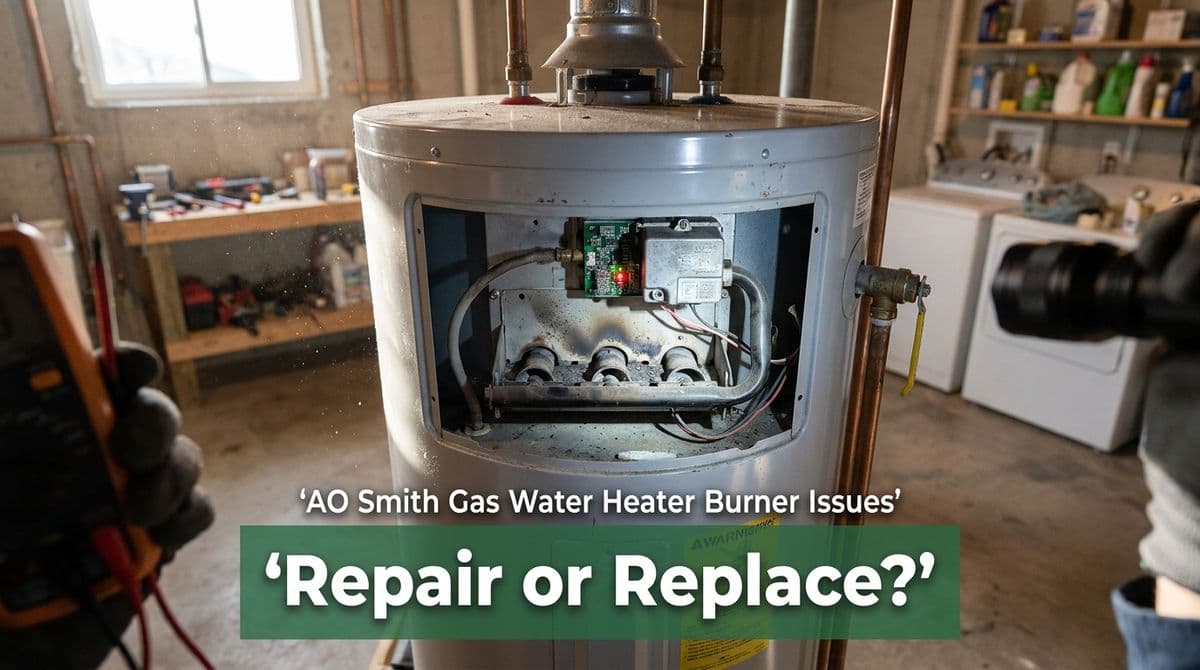
AO Smith Gas Water Heater Burner Problems: What Homeowners Should Know
We recently got a call from a homeowner – let’s call her Linda – who was having trouble with her AO Smith gas water heater. Her son-in-law (also a plumber) had already looked at it and used the built-in diagnostic lights to narrow it down to a burner assembly problem. Linda was hoping to avoid replacing the entire water heater and asked if we could just “bring the burner with us” and swap it out.
That call is actually pretty typical, especially with 5–7-year-old gas water heaters. So I thought I’d walk through what we explained to her: what the burner assembly does, what the blinking lights really mean, how the warranty works on AO Smith units, and how to decide between repairing the burner or replacing the whole heater. I’ll also share what information we like to get before we come out, so we can show up with the right parts and get your hot water back as quickly as possible.
What the Burner Assembly Actually Does
On a tank-style AO Smith gas water heater, the burner assembly is the heart of the system. It’s more than just a little flame at the bottom of the tank.
Typically, the assembly includes:
- Main gas burner – where the gas/air mixture is ignited to heat the water.
- Ignition system – either a pilot light or electronic igniter.
- Thermocouple or flame sensor – confirms the flame is present so gas doesn’t keep flowing if it goes out.
- Gas control valve connection – ties into the thermostat and safety controls.
- Combustion air intake and screen – lets air in for proper combustion and blocks lint/debris.
When everything is working, the thermostat senses the water temperature dropping, signals the gas valve, the burner lights, and you get a clean blue flame heating your tank. When something in that chain fails, you get the symptoms most homeowners notice first: no hot water or very inconsistent hot water.
Common Burner-Related Symptoms on AO Smith Gas Heaters
When Linda called, she already knew she “needed a burner,” but in many cases we’re starting from symptoms. Here are signs the burner assembly (or closely related parts) may be the culprit:
- No hot water at all – especially if you’ve tried resetting the heater and the pilot or burner won’t stay lit.
- Intermittent hot water – works for a while, then goes cold, then mysteriously comes back.
- Burner lights, then shuts off after a few seconds – often a flame sensor or safety issue.
- Unusual flame color – yellow/orange, lazy flames instead of strong blue ones.
- Burner won’t ignite even though you hear a click or smell gas (this one is serious and should be handled by a pro).
Sometimes the “burner problem” is actually a dirty flame arrestor screen, a bad thermocouple, or a failing gas control valve. That’s why we usually want to diagnose in person rather than just guessing and ordering parts.
Understanding AO Smith Diagnostic Lights
Linda’s son-in-law did what we recommend: he looked at the diagnostic LED on the gas control valve. Most modern AO Smith gas water heaters have a small light that blinks in a pattern to tell you what the control is seeing.
While the exact patterns vary by model, here’s the general idea:
- Steady blink every few seconds – normal operation, no errors stored.
- Rapid blinking or multi-blink codes – a specific fault (for example, failed ignition, overheat condition, or sensor failure).
- No light at all – could mean no power to the control, failed control, or in some cases a tripped safety device.
The interpretation chart is usually printed on the water heater’s label or in the manual. If you’re comfortable, you can count the blinks and read the chart yourself. But remember, the light only tells you what isn’t happy – it doesn’t always tell you why. That’s where hands-on testing comes in.
Checking AO Smith Warranty Status: Parts vs. Labor
When Linda mentioned her heater was about six years old, we immediately asked if she knew whether it was still under warranty. Many homeowners assume that once a unit hits 5–6 years, the warranty is done, but that’s not always the case.
How to check your AO Smith warranty
To look up warranty status, you’ll need:
- Model number
- Serial number
Both are typically on a sticker on the side of the tank. On some installations, that sticker is up high or tucked in a tight corner. In Linda’s case, it was high enough that climbing a ladder wasn’t safe for her – which we completely understand.
Once you have those numbers, you (or your plumber) can go to AO Smith’s warranty lookup page or call their support line. They can tell you:
- If the tank is still under warranty.
- What’s covered (usually tank and parts).
- How long the coverage lasts (often 6–10 years depending on model).
What’s usually covered – and what isn’t
On most AO Smith residential units:
- Parts (including burner assemblies, controls, etc.) may be covered during the warranty period.
- Labor (our time to remove and replace the part) is typically not covered by the manufacturer.
So even if your heater is six or seven years old, it’s worth checking – we can often get the parts at no cost from AO Smith, and you only pay for the service and installation.
Repair vs. Replace on a 5–7-Year-Old AO Smith Heater
Linda’s big question was, “Can we just replace the burner? I really don’t want to replace the whole thing if I don’t have to.” That’s a fair concern – no one plans for their water heater to act up at a convenient time.
When it makes sense to repair the burner
We usually lean toward repair if:
- The tank is not leaking and shows no signs of rusting through.
- The unit is in the 5–7-year range and otherwise in good condition.
- The replacement burner/parts are available and reasonably priced.
- You’re not having a history of repeated failures with the same heater.
A burner replacement can add several good years of life to a solid heater, especially if the issue is just a failed sensor, ignition component, or a clogged burner. If parts are under warranty, repair is usually a strong option.
When we start recommending full replacement
On the other hand, we’ll talk seriously about replacing the whole unit if:
- The heater is 8–12+ years old or older than the stated warranty period.
- There are any signs of tank leakage (even a slow seep at the bottom).
- The inside of the tank is likely full of sediment and you’ve had multiple issues.
- The cost of repair is a large percentage of a new heater (often 40–50% or more).
In that situation, putting money into a major repair is a bit like putting new tires and a transmission into a car with 250,000 miles – it might work out, but the risk of another big failure is high.
What Your Plumber Needs Before Coming Out
During our call with Linda, we asked if she could send a picture of the serial number sticker. She wasn’t sure she could safely reach it, and we never want anyone climbing ladders if they’re not steady on their feet. But when it’s possible, a couple of quick photos can save a lot of guesswork.
Information that helps us come prepared
If you’re dealing with an AO Smith burner problem, here’s what’s incredibly helpful to send your plumber ahead of the visit:
- Clear photo of the data sticker
This should show the model and serial number. A straight-on shot with good lighting is ideal. - Photo of the entire water heater
From floor to top, so we can see venting, gas line, water connections, and surrounding space. - Close-up of the gas control valve and burner access area
This helps identify the specific burner and control style. - Location of the heater
Is it in a basement, garage, closet, attic, or crawlspace? Any stairs, tight doors, or ladder-only access? - A description of the symptoms
Include whether you see any diagnostic lights and, if so, how they’re blinking.
With that information, we can usually:
- Verify warranty status with AO Smith.
- Order or stock the correct burner assembly in advance.
- Bring any specialized tools or parts that your particular model tends to need.
The result: fewer surprises on site and less time for you without hot water.
When to Call a Plumber vs. DIY
We’re all for handy homeowners doing basic checks, like reading the diagnostic chart or safely relighting a pilot if the manufacturer’s instructions allow it. But you should call a pro right away if:
- You smell gas or suspect a leak.
- The burner won’t stay lit and the diagnostic light shows repeated ignition failures.
- You see scorch marks, melted plastic, or signs of overheating.
- The tank is leaking or there’s rust around the base.
Gas, combustion air, and venting are not areas where you want to experiment. A licensed plumber familiar with AO Smith heaters can quickly tell you whether a burner repair makes sense or if it’s time to talk about replacement – and help you make the choice that best fits your budget and your home.
If you’re staring at a blinking light on your AO Smith water heater and wondering what to do next, gather whatever information you safely can, then give us a call. We’ll walk you through the options so you’re not left guessing – or left without hot water any longer than necessary.