Tank vs. Tankless: Wrightwood Water Heaters & Hard Water
Hard water in Wrightwood can wreck the wrong water heater. Learn how to choose between tank and tankless, which brands to trust, and why a salt softener is essential.
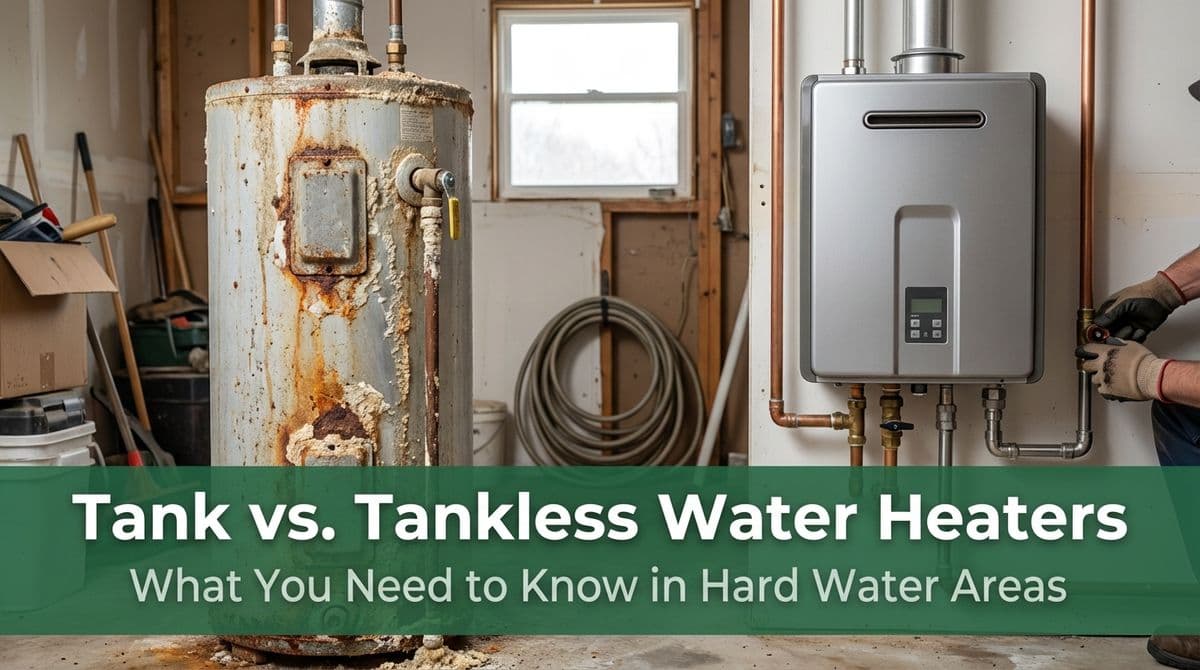
A Wrightwood homeowner stuck between a tank and tankless
We recently got a call from a homeowner up in Wrightwood — let’s call him Tom. Tom’s natural gas tank water heater had suddenly quit on him. The manufacturer (Rheem) tried to help him troubleshoot it over the phone and even shipped out some parts, but the key component — the electronic gas valve — was backordered with no clear date in sight.
Rheem ended up offering Tom a warranty replacement: he’d get store credit through Home Depot for a new water heater if he could have a plumber disconnect, drain, and haul the old unit in. Tom told us he wanted to use that credit to switch from a traditional tank to a tankless water heater and asked us if that was a good idea for a Wrightwood home with very hard water.
That conversation is one we have all the time up here, so we figured we’d walk you through the same guidance we gave Tom — especially around brands, warranties, and why a salt water softener is non‑negotiable for tankless units in our area.
Why we’re cautious about some big‑box water heater brands
Tom’s existing unit was a Rheem purchased through Home Depot, and because of the way the warranty credit works, he was locked into buying whatever brand Home Depot sells — in this case, more Rheem. Tom told us he wasn’t thrilled about that, given the headaches he was already dealing with.
From our plumber’s perspective, we’re very cautious about installing Rheem units, especially up here in Wrightwood. It’s not that we have anything personal against the company; it’s that, in our experience, the product just doesn’t hold up as reliably as some of the professional‑grade brands we normally install.
What Tom was experiencing — repeated troubleshooting calls, parts on backorder, and being pushed toward a full replacement before the heater ever reached its expected lifespan — is pretty typical of what we see with certain big‑box models in hard‑water areas.
What the warranty really covers (and what it doesn’t)
Tom’s water heater was still under a parts warranty, which sounds great on paper. But here’s the catch we explained to him:
- Parts are covered — but only the components themselves, not the labor.
- You pay for the plumber’s time to diagnose, remove, haul, and reinstall the new unit.
- You handle the logistics of getting the old unit back to the store (or pay us to do it).
So while Tom was getting a credit worth several hundred dollars, he still needed to budget for professional labor and potentially upgrades to gas lines, venting, or valves — especially if he switched from tank to tankless.
Hard water in Wrightwood: why it changes the tank vs. tankless decision
When Tom asked us about going tankless, our answer came with a big “it depends” — not just on his budget and hot water needs, but on Wrightwood’s very hard water.
Up here, we typically see hardness around 32 grains per gallon, and we’ve personally tested homes as high as 50 and as low as 28. No matter how you slice it, that’s hard water. And that hardness is the number one factor that destroys tankless water heaters long before their time.
Why hard water is brutal on tankless units
Tankless water heaters use tight, high‑efficiency heat exchangers to heat water on demand. When very hard water passes through those narrow passages, mineral scale (mostly calcium and magnesium) builds up fast.
Without proper water softening, a tankless in Wrightwood will:
- Lose efficiency as scale insulates the heat exchanger
- Need frequent descaling and maintenance
- Face a much shorter lifespan than advertised
- Be more prone to error codes and shutdowns
That’s why we told Tom the same thing we tell every local homeowner: the only way we’ll install a tankless in Wrightwood is with a salt‑based water softener protecting it.
Filtration vs. softening: they’re not the same thing
Tom mentioned he wanted to add a whole‑house filtration system while replacing his water heater. Someone had also told him that water softeners weren’t recommended for tankless units because the salt would corrode the inside of the heater.
We walked him through two key clarifications:
- Filtration and softening are completely different. Filtration targets things like sediment, chlorine, taste, and odor. It does not remove hardness minerals.
- Salt softeners do not corrode tankless units when properly installed and maintained. In fact, they’re what protects them from destructive scale in our water.
In Wrightwood, the only practical way to actually soften water is with a salt‑type ion‑exchange softener. “Salt‑free softeners” and conditioners might help with minor scale issues in milder areas, but they’re simply not up to the job when you’re starting at 30+ grains of hardness.
When a tank water heater still makes sense
We’re not against tankless systems — installed with a proper softener, they can be a great option. But for some Wrightwood homes, a traditional tank is still the more practical choice.
We generally lean toward a quality tank heater when:
- You don’t plan to install a salt water softener
- You want to minimize upfront costs and complexity
- Your hot water usage patterns don’t demand endless on‑demand hot water
Tanks are more forgiving of hard water. They’ll still scale up over time, but they’re not nearly as sensitive as tankless heat exchangers, and maintenance is usually simpler and cheaper.
How we’d design a system for a Wrightwood home like Tom’s
For a homeowner in Tom’s situation — mid‑life Rheem failure, hard Wrightwood water, and a desire to “do it right” this time — here’s the kind of setup we typically recommend:
- Step 1: Decide on softening. If you’re ready to invest in a salt‑based softener, tankless becomes a real option. If not, we’ll usually steer you toward a good‑quality tank.
- Step 2: Choose the right equipment. We prefer professional‑grade brands over big‑box models, especially for tankless. Even if you’re using store credit for the heater itself, we can often help you design the rest of the system around it.
- Step 3: Think beyond the water heater. A softener won’t just protect the heater — it helps your fixtures, dishwasher, laundry, and even your skin and hair.
- Step 4: Plan for maintenance. Tanks benefit from periodic flushing. Tankless units require regular descaling unless softened, and still appreciate annual checkups even with soft water.
Not sure which way to go? Here’s our quick advice
If you live in Wrightwood or another hard‑water area and you’re stuck between tank and tankless, here’s the bottom line we shared with Tom:
- No salt softener planned? Go with a quality tank water heater.
- Willing to install a salt softener? Tankless can be a great long‑term upgrade.
- Leaning on big‑box brands? Understand the limits of the warranty and be prepared for more service calls than with pro‑grade equipment.
If you’d like us to look at your current setup, water hardness, and utility room layout, we’re always happy to come out, take a look, and help you design a system that fits both your home and your budget.