Tankless Error Codes, Scale Buildup & How Descaling Works
Tankless water heater showing a CF error? Learn what critical failure codes mean, how scale clogs your unit, and how real descaling (not just resetting) fixes the problem.
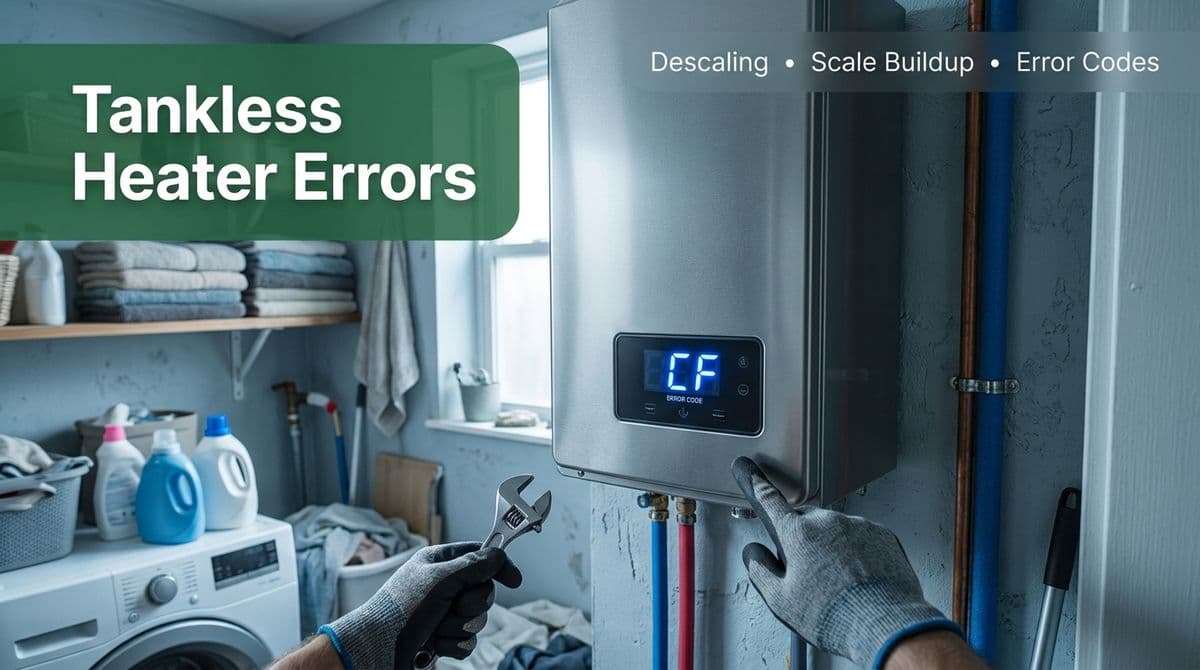
Tankless Water Heater Showing CF Error? Why Reset Isn’t a Fix
We recently got a call from a homeowner — let’s call her Lisa — whose tankless water heater kept flashing a clogged warning. The first time it happened, she unplugged the unit, waited 30 seconds, hit reset, and it worked again… for a while. This time, the reset trick did nothing.
When we asked a few questions, we realized her Navien tankless was likely throwing a CF10 or CF11 “Critical Failure” code. In our experience, Lisa’s situation is exactly what we see with a lot of our customers: the unit has been quietly filling with scale for years, the error finally pops, and repeated resets just kick the real fix further down the road.
So let’s walk through what those error codes mean, why scale is such a problem for tankless heaters, how descaling really works, and why we never recommend relying on the reset button as a solution.
What CF & Other Error Codes Really Mean on Tankless Units
Most major brands — Navien, Noritz, Rinnai, Takagi and others — will flash some version of “CF,” “critical failure,” or “combustion/full blockage” when things get serious. On Navien, codes like CF10 and CF11 often point to a restricted heat exchanger or poor flow through the unit.
By the time you see those codes, the water path inside the heater is usually partially clogged with calcium scale. The unit’s sensors see that it can’t move or heat water properly and, to protect itself, it shuts down.
When we tell homeowners this, we often hear, “But I reset it last time and it came back on.” That’s exactly what happened with Lisa. The problem is, resetting doesn’t clear any of that mineral buildup — it only tells the computer to ignore what it’s seeing until things get worse.
Why Tankless Water Heaters Hate Hard Water
Inside a tankless heater, water passes through a narrow heat exchanger — think of it like a tightly coiled copper highway. In most areas, including a lot of the neighborhoods we serve, the water is hard, meaning it’s loaded with dissolved calcium and magnesium.
Every time you run hot water, a little of that mineral content comes out of solution and sticks to the inside of the heat exchanger. Over time, that scale:
- Narrows the water passages and reduces flow
- Insulates the metal so it takes more gas or electricity to heat the water
- Causes hot-cold-hot “hunting” and noisy operation
- Triggers error codes and, eventually, total shutdown
Tankless units are more sensitive to this than traditional tank heaters because they’re built with tight clearances and aggressive heating surfaces. A little scale goes a long way.
Water Conditioner vs. True Softener: Why It Matters
During our call with Lisa, she mentioned she had “conditioned” water and assumed that meant she didn’t have hard water. We hear this a lot. Here’s how we explained it to her — and how we explain it to many of our customers:
- Salt-free conditioners (often called “descalers” or “conditioners”) do not remove hardness minerals. They may change the way minerals crystallize so they’re less likely to stick to pipes, but the calcium is still there.
- Salt-based softeners use ion exchange to physically remove calcium and magnesium from the water. If you’re not regularly adding salt, you almost certainly don’t have this type of system.
From our perspective as plumbers, only a properly sized, salt-based softener significantly slows scale inside a tankless heater. Conditioners can help a bit, but they’re not a free pass to skip descaling.
How Often Should a Tankless Water Heater Be Descaled?
Based on what we see in the field, a good rule of thumb is:
- Hard water, no softener: Descale once a year.
- Moderate water or salt-free conditioner: Descale every 12–24 months, depending on usage.
- Proper salt-based softener: Descale every 2–3 years, but still have us inspect the unit annually.
We recommended an immediate descale for Lisa because her CF error and reset history told us the heat exchanger had been neglected for too long.
What’s Involved in a Professional Descaling Service?
Homeowners often ask us what they’re paying for when we quote a descaling service. Here’s how we typically handle it:
- Shut down and isolate the unit
We turn off power and gas, close the hot and cold isolation valves, and connect hoses to the service ports. - Set up a circulation pump
A small pump and bucket are used to circulate a descaling solution (often food-grade vinegar or a specialized chemical) through the heat exchanger. - Circulate and dissolve the scale
We run that solution for 45–60 minutes so it can break down mineral deposits inside the unit. - Flush thoroughly
Afterwards, we flush the system with clean water to remove any loosened debris and leftover solution. - Check operation and codes
Finally, we restore power and gas, clear any stored error codes properly, and verify temperature, flow, and combustion readings.
On calls like Lisa’s, we also talk through water treatment options and set a reminder schedule so the unit doesn’t get to critical failure again.
Warning Signs It’s Time to Descale
We encourage homeowners to call us before they hit CF-level failure. Some of the warning signs we look for include:
- Hot water temperature swings or “hunting”
- Reduced hot water flow compared to cold
- New or louder fan/combustion noises
- Longer wait times for hot water to arrive
- Recurring error codes that clear but keep coming back
- An older unit (5+ years) that has never been descaled
If you’re noticing one or more of these, we’d rather come out for a scheduled descale than an emergency no-hot-water call.
Why Repeatedly Hitting Reset Can Make Things Worse
We told Lisa the same thing we tell everyone: don’t rely on the reset button as a fix. Here’s why we keep stressing that point:
- Resetting doesn’t remove scale; it only silences the alarm.
- You can push the unit to run hotter and harder against a blockage, which can overheat components.
- Small issues that could’ve been handled with a simple descale can turn into damaged parts or full replacement.
In our experience, when a tankless is telling you it has a critical failure, it’s doing that to protect itself. The safest move is to shut it down and let a professional diagnose whether descaling alone will solve the problem.
When to Call Us About Your Tankless Water Heater
If your tankless is flashing a CF or critical code, or you’ve been resetting it more than once, it’s time to have us take a look. We can descale the unit, check the rest of the system, and talk through whether a true water softener makes sense for your home.
And if you’re not at the error-code stage yet, that’s even better. An annual or biannual descale is one of the cheapest ways to keep your tankless running efficiently and avoid the kind of cold-shower surprise Lisa’s family went through.